Anthropology’s White Innocence
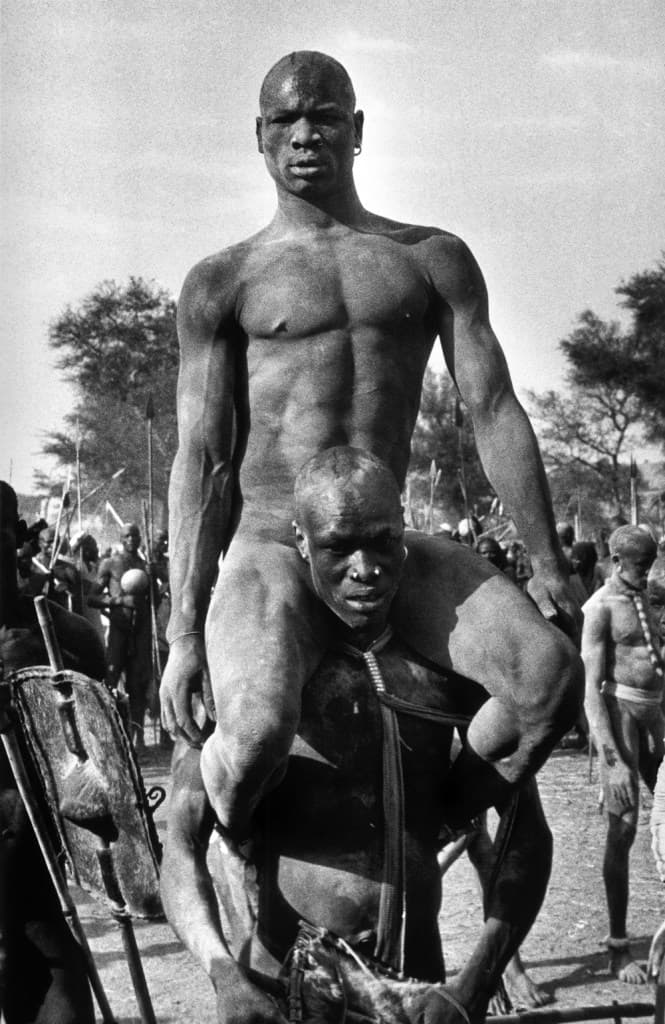
image: Nuba wrestlers, by George Rodger
Anthropology was born from colonialism. There is no way around it. Its very roots are entangled with power, ethnocentrism, and the urge to classify and dissect (also literally) the racialized Other. And yet, students and scholars - no matter how critical, no matter how antiracist and "postcolonial" - still defend its potential. They emphasize its ethnographic method as a way to capture lived culture. But in practice, it keeps circling back to the same object: the non-Western Other. If it can’t step outside its own colonial framework, why cling to it?
Stuart Hall’s reading of fetishism in Representation: Cultural Representations and Signifying Practices shows just how deep this goes. He revisits Leni Riefenstahl’s fascination with George Rodger’s photograph of Nubian wrestlers. She confessed: “Though it is forbidden, I can look at the wrestler’s genitals because they are no longer as they were. Their place has been taken by the head of his wrestling companion.” As Kobena Mercer notes, Riefenstahl's so-called anthropological interest was nothing but an alibi for erotic obsession It is “the secondary elaboration, and rationalization of the primal wish to see this lost image again and again.”
I recognize this logic in my own circles. Classmates and colleagues in anthropology tell me stories of fieldwork that, somehow, always involved some sexual escapade with a local. There was also usually an exclusive desire to share one's life with someone who was also the object of study. In other words: to study Congo, usually involved having a Congolese partner, too. To engage in antiracist scholarship, involved having a racialized partner or child.
Whenever I suggest they research whiteness at home, they seem uninterested. The “authentic” Africa will always be far more enticing and, of course, free from diasporic critique. Anthropology becomes a way to repeat old fantasies under the guise of science. That logic is recognizably embedded in Anthropology itself. It fetishizes the Other while exempting whiteness from being studied at all. It makes whiteness the unblemished reference point, which only reinforces the white supremacy that lies at the very foundation of the field.
In that respect, Gloria Wekker did something radical. In White Innocence: Paradoxes of Colonialism and Race, she used ethnographic tools to study Dutch whiteness, turning the anthropological gaze back on those who usually hold it. It's refreshing, really, and it shows what Anthropology could be if we truly seek to free it from its colonial shackles. As was predictable, such work tends to get dismissed as "unscientific," mere “personal experience.” Because apparently, white people can be studied through Sociology but never Anthropology. Whiteness is universal, not socially construed through history, culture, and the predicament of race... And when studies on whiteness do appear, their findings are often naturalized into human nature itself: (“all humans are xenophobic”). Wekker punctured that illusion and so should we.